Why You’re Still the Bottleneck in Your Business (And How to Fix It)
If you’ve ever caught yourself thinking, “Why am I the bottleneck in my business?” you’re not alone. Most founders and leaders reach a point where everything seems to depend on them. Decisions stall. Projects slow down. Growth plateaus.
At first, it feels like responsibility. Eventually, it becomes constraint.
Here’s the hard truth: if your business can’t move without you, you haven’t built a business. You’ve built a dependency.
The good news is this is fixable. And once you fix it, you don’t just reclaim your time. You unlock scale.
What It Means to Be the Bottleneck
A bottleneck isn’t just about being busy. It’s about being central to too many workflows.
You’re the bottleneck if:
- Decisions wait for your approval
- Your team asks you the same questions repeatedly
- Projects stall when you’re unavailable
- You’re involved in tasks someone else could handle
- You feel like stepping away would cause everything to break
This isn’t a time management issue. It’s a systems issue.
And most of the time, it was created unintentionally.
Why Founders Become the Bottleneck
No one sets out to become the constraint. It happens gradually as the business grows.
1. You Were the System Early On
In the beginning, you had to do everything: sales, operations, hiring, client delivery. You were the fastest and most informed person in every function.
That worked at $100K or even $1M.
It doesn’t work at scale.
What used to be efficiency becomes fragility.
2. You Haven’t Transferred Decision Ownership
Many leaders delegate tasks but keep decisions.
Your team executes, but they still rely on you to:
-
- Approve next steps
- Resolve ambiguity
- Make judgment calls
This creates a hidden dependency. Work flows through you whether you realize it or not.
3. You Don’t Trust the System Yet
Even strong leaders struggle to let go because:
-
- You’ve been burned before
- You believe quality will drop
- You think it’s faster to just do it yourself
In the short term, that might be true.
Long term, it guarantees you stay stuck.
4. Your Processes Live in Your Head
If your team needs to ask, “How do we do this?” you don’t have a process. You have memory.
That creates constant interruptions and inconsistent execution.
And it makes you the only source of truth.
5. You’re Rewarded for Being Needed
This one is subtle.
Being needed feels valuable. It reinforces your importance in the business.
But leadership isn’t about being needed. It’s about building something that works without you.
The Real Cost of Being the Bottleneck
Most leaders underestimate the impact.
Being the bottleneck doesn’t just slow things down. It affects every layer of your business.
Growth Stalls
You can’t scale decision-making if it depends on one person. Opportunities get delayed or missed entirely.
Team Performance Drops
Your team either waits or guesses. Neither leads to consistent outcomes.
Over time, high performers disengage because they don’t have ownership.
Burnout Increases
You’re always “on.” Even when you’re not working, you’re thinking about what might break without you.
That’s not sustainable.
Business Value Decreases
A business that depends on the owner is harder to grow, harder to sell, and harder to step away from.
Freedom isn’t just a lifestyle goal. It’s a structural advantage.
How to Fix It and Remove Yourself as the Workflow Center
Freedom in your business isn’t built by working less. It’s built by designing systems that don’t require you.
Here’s how to start.
1. Identify Where You’re the Constraint
Start with visibility.
Track:
-
- What decisions only you can make
- What tasks keep coming back to you
- Where projects slow down waiting on you
You’re looking for patterns, not one-off issues.
Most leaders find that 20 percent of their involvement creates 80 percent of the delay.
2. Separate Decisions From Tasks
Delegation fails when you only hand off execution.
Instead, define:
-
- What decisions your team can make without you
- What thresholds require escalation
- What “good” looks like
For example: Instead of “Draft the proposal and send it to me,” shift to “Draft and send proposals under $25K without approval. Escalate anything above that.”
Now you’ve removed yourself from the workflow, not just the task.
3. Document the Repeatable
If something happens more than once, it should be documented. This doesn’t mean building complex manuals.
It means capturing:
-
- Steps
- Criteria
- Examples
Simple tools work:
-
- Checklists
- Loom videos
- Short SOPs
Documentation turns your thinking into a shared asset.
4. Build Roles, Not Just Hires
If your team depends on you, it’s often because roles aren’t clearly defined.
Strong roles include:
-
- Ownership of outcomes, not just tasks
- Clear decision rights
- Defined success metrics
When roles are clear, your involvement becomes optional, not required.
5. Install a Decision Framework
Your team doesn’t need your constant input if they understand how you think.
Give them:
-
- Priorities
- Constraints
- Trade-off rules
For example:
-
- Speed over perfection in early-stage sales
- Margin protection over growth in operations
- Client experience over internal convenience
Now decisions can be made without waiting for you.
6. Accept Imperfect Execution
This is where most leaders get stuck.
No one will do it exactly like you. But “exactly like you” isn’t the goal. Scalable and consistent is.
If your standard is perfection, you’ll always be the bottleneck. If your standard is effective and repeatable, your business can grow.
7. Replace Yourself in Layers
You don’t remove yourself all at once.
You do it in stages:
-
- Task delegation
- Decision delegation
- Outcome ownership
Each layer reduces your involvement while increasing your team’s capability.
What It Looks Like on the Other Side
When you’re no longer the workflow center, everything changes.
- Decisions happen faster
- Your team operates with confidence
- You focus on strategy, not execution
- The business grows without constant input
Most importantly, you gain optionality.
You can step back, scale up, or shift focus without everything depending on your presence.
When to Get Help
Many leaders know what to do but don’t have the time or structure to implement it.
This is where strategic support matters.
An experienced virtual assistant or operations professional can:
- Document processes
- Manage workflows
- Own execution layers
- Reduce daily interruptions
The goal isn’t just support. It’s removing dependency.
When done right, support doesn’t add complexity. It removes it.
The Bottom Line
If you’re asking, “Why am I the bottleneck in my business?” the answer is simple:
Because too much depends on you. And while that might have been necessary early on, it’s now the thing holding you back.
Freedom isn’t about stepping away randomly. It’s about intentionally removing yourself as the center of every workflow.
Build systems. Transfer decisions. Define ownership.
That’s how you stop being the bottleneck and start leading a business that actually runs.
If you’re ready to stop being the bottleneck and start building a business that runs without you, it starts with the right system.
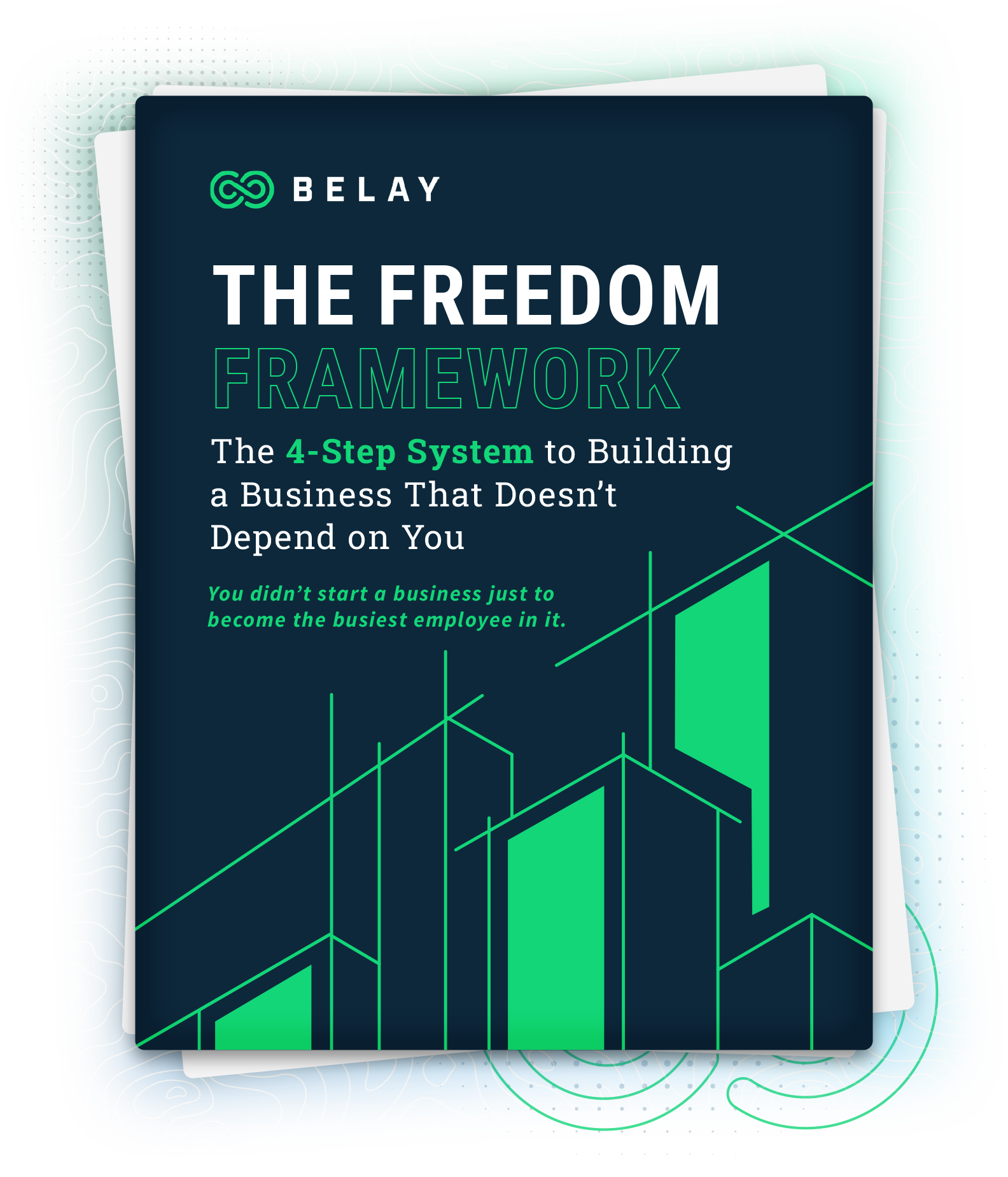
Download The Freedom Framework and learn the 4-step approach to reclaiming your time, transferring ownership, and designing a business that doesn’t depend on you.
The Freedom Framework- The 4-Step System to Building a Business That Doesn’t Depend on You
You didn't start a business to become its busiest employee. The Freedom Framework is a 4-step system designed to pull you out of the "Success Trap" and transition you from the operational bottleneck to the architect of your organization. Through a targeted Role Audit, defining High-Value Work, installing Ownership Infrastructure, and using the Delegation Ladder, you will learn to empower your team to lead while you focus on vision. Stop managing tasks and start leading growth. Whether through an elite Executive Assistant or expert Financial Solutions, BELAY helps you reclaim 10–20+ hours a week.