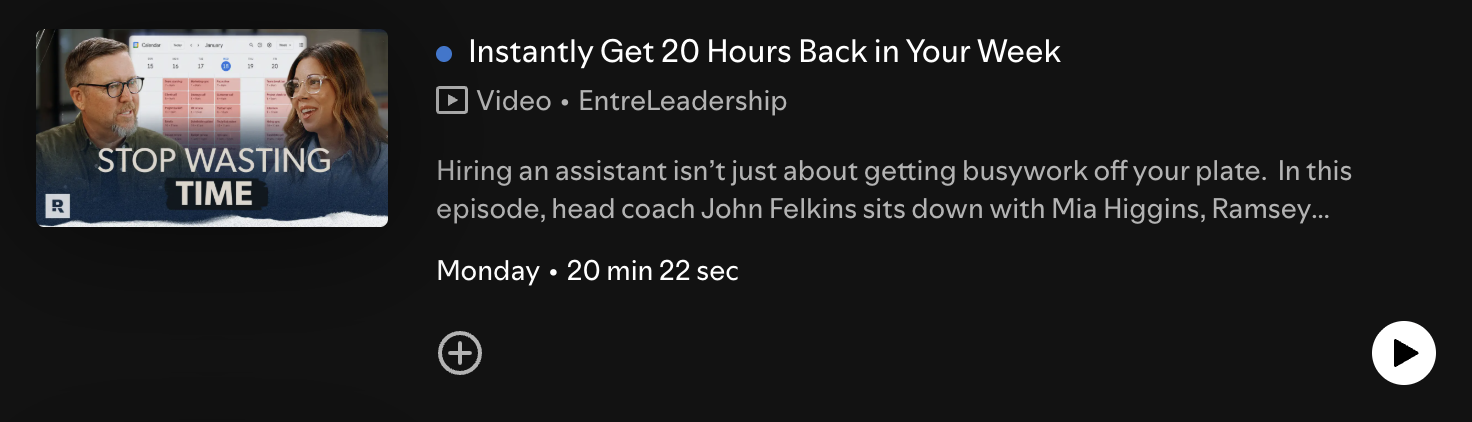
What Ramsey's Mia Higgins says about turning an assistant into a strategic partner
The right assistant could give a business owner 10, 15, maybe even 20 hours back each week. That's how Dave Ramsey opens the EntreLeadership episode Instantly Get 20 Hours Back in Your Week, and the rest of the conversation explains how leaders actually get there.
EntreLeadership head coach John Felkins sits down with Mia Higgins to talk through what leaders get wrong about assistants and what separates a good one from a great one.
Mia knows both sides of the relationship. She's been at Ramsey for 13 years, spent eight of them as an assistant, and now leads a team of about 40 assistants across the company.
What do leaders get wrong about working with an assistant?
The biggest mistake is seeing an assistant as someone who only takes and completes tasks. Mia says that picture misses most of what the role can offer.
"There is still the perspective of the old-time secretary and just a task taker or just an executor. When we think about it in that way and have that mindset, we really miss the true value that's in the role."
She's watched the role change a lot during her time at Ramsey, especially in the last few years with AI. Leaders who hire with that old picture in mind end up getting far less out of the relationship than they could.
What does a great assistant actually do?
A great assistant acts as a strategic partner who understands the business well enough to help move the work forward. Mia describes someone who can see business problems and connect the dots, then represent you well when you can't be in the room.
As she reminds John, you're one person. You can't be everywhere at once, and a great assistant helps you show up in more places than you could on your own.
Why does your assistant need context?
Your assistant can only act on your behalf if they understand how you think and what you're working toward. Mia calls this the thing leaders miss most. They want an assistant who communicates like them, but they never invite that person into the business.
"They can't solve what they can't see."
John admits this one hits close to home. He works with his assistant and says giving context doesn't come naturally to him.
"It doesn't for me. And let me just say, for the leaders out there, it's not because of a lack of trust. I just have to slow down enough to take the time to give the context."
The leader may know it isn't about trust, but the assistant doesn't. Without context, an assistant can start believing they aren't trusted and get stuck there.
One simple fix is bringing your assistant into meetings. Mia encourages assistants to see those moments as a chance to gain context, since they're there for a lot more than taking notes.
Knowing your leader well goes beyond the calendar, too. Mia supported [Blake's full name and title] for about six years and says she got to the point where she could look at him and tell when he was having a hard day or when something needed to be talked through. That level of understanding comes from both people investing in the relationship.
How do you build trust with a new assistant?
Start small and expand as your assistant proves reliable. Even when you hire someone with every quality you want, Mia says you don't need to hand over everything on day one.
"And trust starts small."
Hand off a few things first and watch whether they follow through. Then give more. John connects this to Dave's Quick Read on delegation, which makes the same case for starting with little things and building from there.
When you're deciding whether to hand off more, Mia suggests paying close attention to your assistant's judgment and how they communicate on your behalf. You won't always have time to give full context, and a great assistant can operate through some ambiguity.
What can assistants do to earn more trust?
Assistants earn bigger responsibilities by being reliable with small ones. Mia's first piece of advice for assistants is simple:
"Do what you say you're going to do."
Dropped balls early on can break trust. It can be rebuilt, but it slows everything down. So she tells assistants not to try taking everything on at once.
From there, stay observant. If you notice your leader spending time on something you could handle, bring it up. Mia also encourages assistants to care about what the leader cares about. That's how you earn respect and show you're on their team.
Many assistants hesitate to start those conversations, though. Mia says they often don't want to overstep or waste a leader's time.
"They see themselves as more of an inconvenience rather than seeing themselves as that strategic thought partner that's really going to bring value to this executive."
What should you look for when hiring an assistant?
Look for soft skills first. Mia says people would be surprised by how little of a skills interview she spends on technical ability.
"When I'm doing skills interviews, for instance, for assistants, I think people would be surprised to know I maybe spend 10% of the time on hard skills."
Knowing how to manage a calendar or take notes is what she calls "permission to play." The rest of her interview focuses on emotional intelligence and communication.
High EQ means an assistant can read a room, including what goes unspoken, and has the confidence to share what they noticed with their leader afterward. Strong communication means being clear and concise while also listening well. Mia says active listening is the part of communication people forget about.
To spot those qualities, she recommends having several conversations with a candidate and asking scenario questions. One she might use: What would you do if your leader wasn't inviting you in and you didn't feel like a trusted partner?
When John asks her to name the one trait she looks for most, Mia pairs two words.
"I always combine two words together and that's humble confidence."
She wants someone who knows their worth and isn't looking to the work for affirmation, but who's still coachable. She says she can teach almost anybody how to work in Outlook. Character is much harder to teach. It's the same bar BELAY holds: only the top 3% of applicants are accepted.
How should you measure your assistant's performance?
Define what great looks like, then talk openly about the gaps. When Mia first stepped into leading the assistant team, Ramsey had no way to assess its assistants at all. Over time, the team moved away from checklists and scores toward real conversations.
The key is getting your assistant bought into the growth goals. Start with what you need and what great looks like. Then work backward to where your assistant is today and talk about what would have to be true to close that distance.
Mia also recommends making the partnership itself part of the review. Decide together what more you both want from the working relationship. Skills still matter, but she suggests assessing them as part of that bigger picture.
Why does the assistant role matter so much?
A great assistant finds fulfillment in someone else's success. Mia says that's what she misses most about being an assistant herself.
"It's the partnership. It's the relationship that comes with that partnership and getting to see somebody else succeed."
She looks for that same heart in the people she hires. The best assistants light up when they talk about taking chaos off a leader's plate, and they don't need the spotlight to feel like their work matters.
Listen to the full conversation between Mia Higgins and John Felkins on EntreLeadership for more on building trust and hiring an assistant who becomes a true partner.
If you're ready to protect more of your time for the work only you can do, get matched with your right-fit BELAY Executive Assistant. More than 25,000 leaders have trusted BELAY to match them with the kind of partner Mia describes.
FAQ
How much time can an assistant give you back?
On the episode, Dave Ramsey says the right assistant could give you 10, 15, maybe even 20 hours back each week by handling work like email, scheduling, paperwork, and travel. Many BELAY clients reclaim 10+ hours a week.
What's the biggest misconception about working with an assistant?
Many leaders still picture an assistant who only takes tasks. Mia Higgins says that mindset misses the real value of an assistant who can act as a strategic partner.
How do you build trust with a new assistant?
Start with small responsibilities and watch how reliably your assistant follows through. As they prove their judgment and communication, you can hand off bigger work.
Why does an assistant need context from their leader?
An assistant can only represent you well if they understand how you think and what you're working toward. As Mia puts it, they can't solve what they can't see.
What soft skills should a great assistant have?
Mia looks for high emotional intelligence, including the ability to read a room, along with clear communication and active listening.
How should you review your assistant's performance?
Define what great looks like, talk openly about gaps, and make sure your assistant is bought into the growth goals. Include a conversation about how to deepen the partnership.